
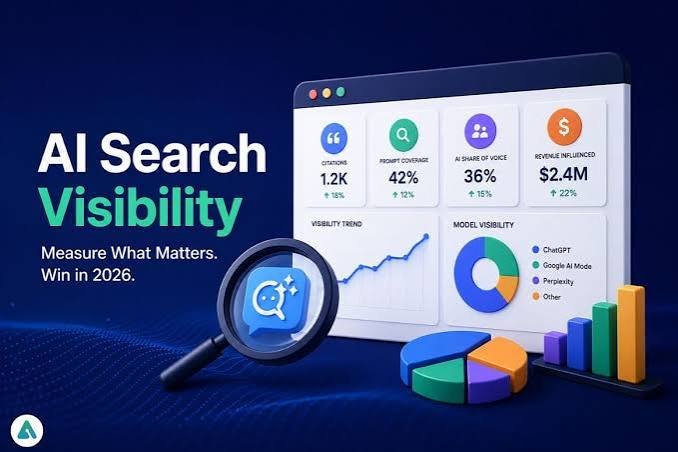
If you’ve been tracking your website’s SEO performance the same way you did three years ago, your ai search visibility metrics kpis are probably lying to you — or at least leaving out half the story.
Here’s the thing: the search landscape shifted quietly but dramatically. Google’s AI Overviews, Bing Copilot, ChatGPT search, and Perplexity are now answering millions of queries before users even click a link. Traditional ranking reports still show your position on page one — but they don’t tell you whether an AI cited your content, paraphrased your data, or recommended your product to someone who never visited your site.
That gap? It’s real, and if you’re not measuring it, you’re flying blind.
Why Your Old KPIs No Longer Tell the Full Story
Let me give you a real-world scenario. A mid-size SaaS company I spoke with earlier this year was celebrating stable keyword rankings — top 5 for their core terms, solid click-through rates. But their organic traffic had quietly dropped 18% over six months.
The culprit wasn’t a Google penalty. It was AI Overviews. For nearly 40% of their target queries, Google was now surfacing an AI-generated summary at the top — pulling from authoritative sources, none of which were them. Their rankings looked fine. Their visibility? Not so much.
This is the new gap that traditional dashboards don’t capture. And it’s exactly why tracking ai search visibility metrics kpis has become non-negotiable for any brand serious about organic growth in 2024 and beyond.
The Core AI Search Visibility Metrics You Actually Need to Track
1. AI Overview Impression Share
Google Search Console now logs impressions even when AI Overviews appear — but it doesn’t separate them cleanly yet. You need to cross-reference your impression data with manual SERP audits using tools like SE Ranking, Semrush’s AI Overview tracker, or even manual spot-checks on high-volume queries.
What you’re measuring: How often does your content appear within or alongside an AI-generated summary?
A realistic starting benchmark is to pull your top 50 non-branded queries, check which ones trigger AI Overviews, and then verify whether your domain appears as a cited source. Most brands discover they’re cited in fewer than 10% of relevant AI Overviews — which is the actual problem to fix.
2. Citation Rate in AI-Generated Answers
This is the big one that almost nobody tracks systematically. When tools like Perplexity, ChatGPT with web browsing, or Gemini pull information from the web, they often cite sources. Are you one of them?
You can test this manually by running your target queries through two or three AI search tools weekly and logging whether your domain appears as a citation. For larger operations, there are emerging tools (Profound, Otterly.AI, AthenaHQ) that automate this monitoring.
Your KPI here is simple: citation frequency per query cluster. Start tracking it monthly. Even rough data will show you which content categories AI tools trust — and which they skip.
3. Brand Mention Rate Without a Direct Link
Here’s a subtler metric that matters more than people realize. AI tools frequently mention brands, products, and expert sources without linking to them directly. If an AI answer says “tools like [Your Brand] are commonly used for X,” that’s influence — even without a click.
Track this through brand monitoring tools (Mention.com, Brand24, or even Google Alerts set to your brand name). Create a separate log specifically for AI-sourced mentions versus traditional media mentions.
4. Zero-Click Impact Score
Not all zero-click searches hurt equally. If someone asks “what is [concept your brand owns]” and the AI answers it correctly and attributes your brand — that’s brand-building even without a visit.
The zero-click impact score is calculated informally: compare the queries that get AI-answered against your historical traffic from those same queries. The delta tells you how much volume you’ve “lost to AI” — but context matters. Brand-attributing answers may still be driving conversion downstream.
5. Structured Data Eligibility Rate
This one sits at the intersection of technical SEO and AI readiness. AI tools are more likely to cite pages with clean, structured, machine-readable content. Check what percentage of your key pages have valid schema markup (FAQ, HowTo, Article, Product, Review). This is a direct input metric — one you can control — that correlates with AI citation rates.
Run a schema audit quarterly. Low eligibility means AI crawlers have a harder time parsing and trusting your content.
Three KPIs to Retire (Or At Least Reweight)
Average Position — Still useful, but no longer the headline number. A position 2 result that appears below an AI Overview gets less attention than a position 4 result cited inside the AI answer.
Click-Through Rate in Isolation — CTR has declined across informational queries due to AI answers. Penalizing your content team for lower CTR on informational posts when AI Overviews are the cause is measuring the wrong thing.
Keyword Ranking Volume — Ranking for 500 keywords means less if 60% of those triggers produce AI-answered SERPs. You need ranking + AI presence data together.
How to Build an AI-Ready KPI Dashboard
You don’t need an enterprise tool budget to start. Here’s a simple stack that works:
Step 1 — Weekly SERP Sampling. Pick 20–30 high-priority queries. Run them manually in an incognito browser. Log: Does an AI Overview appear? Is your site cited? What source is cited instead?
Step 2 — Monthly AI Tool Audit. Run those same queries through Perplexity and Bing Copilot. Log citation and brand mention data in a shared spreadsheet. Yes, this is manual. Yes, it’s worth it until better tooling matures.
Step 3 — Connect Schema Coverage to Citation Correlation. Over time, you’ll notice patterns: pages with HowTo schema get cited more on procedural queries; pages with FAQ schema show up in AI answers to question-style searches. This correlation becomes your content strategy.
Step 4 — Track Branded AI Impressions. Set up a Google Alert and a Brand24 stream specifically for AI-generated contexts. When you spot a mention, log the platform, query intent, and whether a competitor was mentioned alongside you.
A Note on What “Good” Looks Like
There’s no industry benchmark yet for most of these AI search metrics — the field is genuinely that new. But here’s a practical way to set targets:
If 30% of your top-100 queries trigger AI Overviews, your near-term goal should be to appear as a cited source in at least 20% of those. If you’re at 5%, that’s your baseline — and every percentage point up is real, measurable progress.
The brands getting ahead of this right now aren’t doing anything magical. They’re writing more structured content, using proper schema, earning authoritative backlinks that signal trust to AI crawlers, and actually tracking what’s happening in AI search results instead of hoping their keyword tools will figure it out.
The Mindset Shift That Changes Everything
Stop Optimizing Just for Clicks — Start Optimizing for Citations
The mental model shift required here is genuinely difficult for teams that have spent years in a clicks-and-rankings world. But it’s the right one.
Your content’s job is no longer just to rank. It’s to be trusted, cited, and mentioned by AI systems that are now the first layer of information delivery for hundreds of millions of searches per day.
That means writing content that is clear, well-structured, and factually specific. It means establishing topical authority through consistent coverage of a subject area. It means earning the kind of domain reputation that makes AI tools default to you as a reliable source.
None of that is revolutionary SEO advice — but the reason it matters has shifted. You’re not just trying to impress a ranking algorithm anymore. You’re trying to be the source an AI chooses when it explains your topic to a curious stranger.
That’s a higher bar. And it’s worth every KPI you build to measure it.