
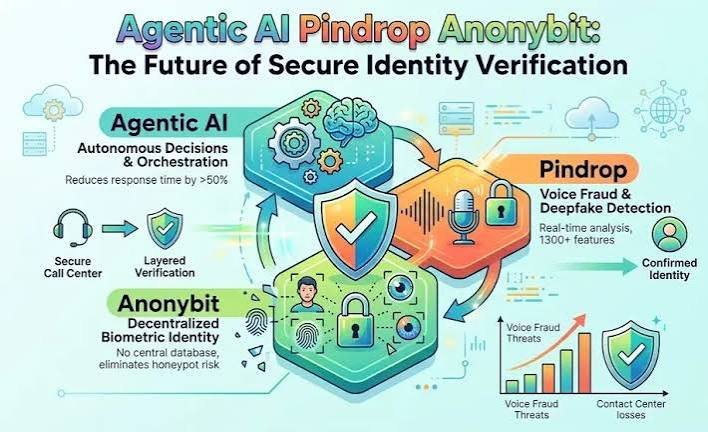
If you’ve been paying attention to what’s happening in fraud, identity theft, and voice-based scams, you’ve probably noticed things are moving at a speed that most organizations simply aren’t prepared for. Agentic AI Pindrop Anonybit — three distinct but deeply connected pieces of a security puzzle — are quietly becoming the most talked-about combination in identity protection right now. And honestly, the timing couldn’t be more urgent.
Let me walk you through what this actually means in the real world, why it matters to your business, and how these three elements work together to close gaps that traditional security tools leave wide open.
The Fraud Problem Nobody Is Talking About Honestly
Here’s a number that stopped me cold when I first came across it: contact centers logged roughly 2.6 million fraud incidents in 2024, with estimated losses hitting $12.5 billion. That’s not a rounding error. That’s a structural failure.
What changed? The same generative AI tools that help marketers write copy and developers debug code are being weaponized by fraud rings. A bad actor today doesn’t need technical expertise. They need three seconds of someone’s voice — from a voicemail, a LinkedIn video, a YouTube clip — and they can clone it well enough to fool a call center agent. Voice cloning, deepfake audio, and automated bots that can navigate IVR phone trees now handle attacks that used to require real human fraudsters.
Deepfake call activity exploded by over 1,300% in 2024, going from roughly one incident per month to seven per day by the end of the year. In the insurance sector alone, synthetic voice attacks jumped 475% in that same period. Banking saw a 149% rise in voice-based fraud targeting high-value transactions and account changes.
The point isn’t just that fraud is growing. It’s that the nature of fraud has fundamentally changed. Rule-based detection systems were built for a different era. They catch known patterns. They don’t catch adaptive, AI-powered attackers who learn thresholds and route around them within days.
That’s the exact gap that the combination of agentic AI, Pindrop, and Anonybit is designed to close.
What Agentic AI Actually Means (And Why It’s Different from a Chatbot)
There’s a lot of buzzword confusion here, so let’s be direct. Agentic AI is not just a smarter chatbot. It refers to AI systems that pursue goals autonomously — watching signals, making decisions across multiple steps, routing cases, and escalating risk without waiting for a human to approve each move.
In a security context, that autonomy is the whole point. Fraud attacks unfold in milliseconds. A system that flags a suspicious call and then waits for a fraud analyst to open a ticket on Monday morning has already lost. The attacker is long gone, and the damage is done.
Think about what a real fraud attempt looks like today. A bot dials a bank’s contact center using a cloned voice. It knows the account holder’s name, address, and last four digits of their card — all scraped from a data breach. It answers security questions correctly. It requests a password reset and a SIM swap. The entire interaction takes under four minutes. No human analyst can review that in real time without agentic support.
Agentic AI acts as the orchestration layer: it ingests voice risk scores, behavioral signals, session context, and authentication results simultaneously, then makes a decision — block, flag, step up, escalate — faster than any human can. It’s not replacing your fraud team. It’s giving them the ability to work at machine speed.
Pindrop: The Voice Intelligence Layer That Can Spot a Fake
Pindrop has been focused on one thing for over a decade: figuring out whether the voice on the other end of a call is real, and whether the person speaking is who they claim to be. That might sound narrow, but the technology underneath it is anything but.
Their approach is built on the idea that synthetic speech leaves traces — acoustic artifacts, unnatural frequency patterns, micro-timing inconsistencies — that humans can’t detect but machines can measure. They call this “liveness detection,” and it works even when the deepfake audio is good enough to fool a trained call center agent.
The results in real deployments speak for themselves. HealthEquity, a healthcare financial company, reported a 90%+ reduction in voice fraud after deploying Pindrop’s system. Seven of the top ten U.S. banks are already using the technology. In 2026, TIME named Pindrop to its list of the most influential software companies, putting it alongside names like Microsoft, Adobe, and Figma.
Their newer product, Fraud Assist, takes this further by embedding agentic AI directly into the fraud investigation workflow. Instead of an analyst manually listening to flagged calls, reviewing notes, and writing case summaries, the system delivers real-time call summaries, voice risk scores, and auto-generated documentation in one interface. At FNBO (First National Bank of Omaha), that translated to a 50% improvement in fraud case accuracy. Across beta customers, analyst efficiency improved by up to 70%. The projected annual savings per organization: around $1 million.
That’s not a pilot program result. That’s production-grade ROI.
Anonybit: Solving the Biometric Storage Problem Nobody Wanted to Admit Existed
Here’s the uncomfortable truth about most biometric authentication systems: they’re only as secure as the database holding your biometric data. And that database is a target. A massive, valuable, very attractive target.
When a password database gets breached, you reset your password. When a biometric database gets breached — fingerprints, voice prints, facial scans — you can’t change your face. The data is permanent. The exposure is permanent.
Anonybit was built to solve this. Their approach uses a decentralized architecture that eliminates the central biometric database entirely. Instead of storing a complete biometric template in one place, the system fragments and distributes the data across a decentralized network. No single node holds enough information to reconstruct a usable identity. There’s no central vault to crack.
In May 2025, Anonybit launched its secure agentic workflows product — described as the first production-grade implementation of agentic commerce scenarios using decentralized biometrics. The reported architecture supports responses in around 200 milliseconds with 99.999% uptime assurance, and it integrates into enterprise environments through connections with Microsoft Entra and PingOne DaVinci. It supports face, voice, iris, and palm modalities, and a no-code integration with platform SmartUp followed in July 2025 — meaning security teams without dedicated engineers can now deploy it.
The decentralized approach also aligns with where regulation is heading. The EU AI Act moves into full enforcement in August 2026, requiring transparency and risk management standards for organizations using automated systems in consumer interactions. Building this kind of compliant infrastructure now is significantly cheaper than scrambling to retrofit under a regulatory deadline.
How the Three Layers Work Together
Here’s where the real value becomes clear — not in any single technology, but in how they combine.
Imagine a financial services company running a voice-enabled customer service line. A caller contacts the center to request a wire transfer. Here’s what the layered system does, in sequence:
Step 1: Agentic AI begins monitoring the call from the moment it connects — pulling in session context, device signals, and behavioral patterns before the caller has even finished their first sentence.

Step 2: Pindrop’s voice intelligence analyzes the audio in real time. Is this a live human? Does the voice match the enrolled profile? Are there acoustic markers of synthetic generation? The risk score updates continuously throughout the call.
Step 3: If the risk score crosses a threshold, the agentic system triggers a step-up authentication — routing to Anonybit’s biometric verification layer, which confirms identity against the decentralized biometric record without exposing that record to a central database attack.
Step 4: If verification passes, the transaction proceeds. If it fails or the signals remain ambiguous, the call escalates to a human fraud analyst — with a complete AI-generated case summary already waiting for them.
The whole process runs at machine speed. The analyst only touches cases that genuinely need human judgment. And the attacker — even one using a sophisticated voice clone and accurate personal data — hits a wall they can’t route around with a simple rules exploit.
Who Needs This Stack Right Now?
Banking and financial services face the most immediate exposure. High-value transaction authorization, SIM swap requests, and account changes are the primary targets, and the synthetic voice threat in these channels rose nearly 150% in a single year.
Healthcare is close behind. More than half of fraud attempts hitting healthcare contact centers now involve AI-generated elements — synthetic voices, automated bots, and IVR reconnaissance designed to extract protected health information or manipulate patient benefits. HSAs and FSAs are particularly attractive because they hold liquid value.
Insurance, government agencies, and any organization handling identity verification at scale are all in the same position: the old tools weren’t designed for this threat model.
The organizations that are building this infrastructure now will spend their time running investigations and improving outcomes. The ones that wait will spend their time explaining breaches.
The gap between fraud capability and fraud defense has never been wider. But it’s also never been more closeable. The combination of agentic AI Pindrop Anonybit gives organizations something they haven’t had before: a security stack that operates at the same speed and sophistication as the attacks it’s designed to stop.
That’s not a vendor pitch. That’s just the math on where fraud is going and what it takes to get ahead of it.