

Most companies charging into AI right now are solving the wrong problem. They’re buying the best models, hiring prompt engineers, and spinning up pilots — and then wondering six months later why nothing actually changed. The uncomfortable answer, which very few consultants will tell you because it doesn’t sell well, is this: AI transformation is a problem of governance, and almost no organization is treating it that way.
This isn’t a technology problem. It never really was.
When the Pilot Works But the Organization Doesn’t
Let me tell you about something that happens constantly in large enterprises. A team of enthusiastic engineers builds a genuinely impressive AI tool — maybe it automates contract review, or surfaces customer churn signals three weeks early, or drafts first-pass reports that used to take analysts two days. The demo goes beautifully. Leadership claps.
Then it dies quietly in a corner.
Why? Not because the model was bad. Not because the data pipeline broke. But because nobody decided who owned the output. Was the AI’s contract summary legally binding? Could a sales rep act on the churn prediction without manager approval? Who was responsible when the AI-drafted report had a number that was slightly off and a junior analyst sent it to a client without reading it?
These are governance questions. And organizations that haven’t answered them before deploying AI will answer them the hard way — after something goes wrong.
A real example: in 2023, Air Canada’s chatbot gave a passenger incorrect information about bereavement fares. When the airline tried to disclaim responsibility by arguing the chatbot was a “separate legal entity,” a Canadian tribunal rejected that argument entirely. Air Canada was held liable. The lesson wasn’t that their AI was bad. It was that they had no governance structure defining accountability for what the AI said to customers.
What AI Governance Actually Means in Practice
Governance is one of those words that gets used in boardrooms and means nothing to the people actually doing the work. So let’s be specific.
AI governance means answering four things before you ship anything:
Who decides what the AI is allowed to do? This sounds obvious until you realize that in most companies, the answer is “whoever built it.” That’s not governance — that’s improvisation. Real governance means a cross-functional group (legal, operations, risk, the actual end users) has signed off on the use case, the boundaries, and the escalation path when the AI produces something unexpected.
Who is accountable when it’s wrong? Not responsible in a vague moral sense — accountable in an operational sense. There needs to be a name attached to every AI system in production. A human name. That person’s job includes monitoring outputs, handling edge cases, and deciding when the system needs to be pulled.
How does the AI’s work get checked? Automation bias is real and dangerous. Studies in radiology have shown that when AI flags an image as clear, radiologists are less likely to catch abnormalities they might have otherwise caught on their own. The same dynamic plays out in finance, law, HR, and customer service. Governance defines the human review checkpoints — not because AI is untrustworthy, but because every system needs oversight.
What happens when the rules change? Regulations change. Business contexts shift. The AI that was appropriate six months ago might not be appropriate today. Governance includes a review cadence — not a one-time ethics review at launch, but ongoing assessment.
The Real Cost of Skipping Governance
Here’s what I’ve seen happen when organizations skip this step and go straight to scaling.
A financial services company rolled out an AI hiring screen that was supposed to reduce bias. Because nobody had defined what “bias-free” meant operationally, or who was responsible for auditing the outputs, the system quietly developed a preference pattern that deprioritized candidates from certain geographic regions — areas that happened to correlate with demographic groups the company was legally obligated to consider fairly. It went unnoticed for eight months.The legal exposure was significant. More importantly, real people were affected.
That’s not a cautionary tale about AI being dangerous. It’s a cautionary tale about what happens when you deploy a powerful system without first answering the basic governance questions.
The cost of this gap isn’t just reputational or legal — it’s operational. Teams lose trust in tools that produce outputs nobody feels confident acting on. Adoption stalls. The investment doesn’t return. And then everyone concludes that “AI doesn’t work in our industry,” when the reality is that AI works fine — the organization just wasn’t structured to receive it.
Why Most Organizations Aren’t Ready (And What to Do About It)
The reason governance gets skipped isn’t laziness. It’s structural. AI initiatives are almost always driven by technology teams or innovation labs, and governance is seen as the province of legal and compliance — two groups that are typically brought in to slow things down, not build them. So there’s an implicit assumption that governance is something you bolt on after you’ve proven the concept.
That assumption is backwards. Governance needs to be designed alongside the product, not retrofitted onto it.
For organizations that are genuinely committed to this, a good place to begin is with the following practical steps:
Start with an AI inventory. Before you can govern anything, you need to know what you’re running. Most large companies, if they’re honest, have no centralized view of all the AI and automated decision-making systems operating across departments. Build that list first.
Then map the risk tier of each system. Not every task requires the same amount of supervision or attention. An AI that helps the marketing team brainstorm subject lines sits in a very different risk category than one that recommends loan approvals or medical treatment plans. Your governance framework should scale with risk.
Then assign ownership — real ownership, not committee responsibility. One person, one system. That person is not just technically responsible but operationally accountable for what the system does in the world.
Finally, build the feedback loop. Create a structured way for end users to flag when the AI behaved unexpectedly. Not a generic feedback form — a workflow that routes the report to the owner, triggers a review, and produces a documented response. This is how you catch problems before they compound.
The Bigger Picture
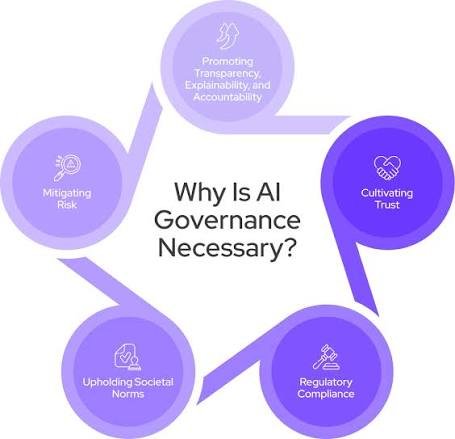
There’s a reason the EU AI Act, the US executive orders on AI, and emerging frameworks across Asia all center heavily on governance, accountability, and documentation. Regulators are not trying to slow down AI — they’re responding to a real pattern where powerful systems get deployed into high-stakes environments with nobody clearly responsible for what happens next.
The organizations that will actually benefit from AI — not just run experiments with it — are the ones that treat governance as infrastructure, the same way they treat data security or financial controls. Not exciting. Not a competitive differentiator in itself. But the foundation that makes everything else possible.
The technology is ready. The models are good enough. The bottleneck now, almost universally, is whether your organization has the structures, the accountability, and the clarity of decision-making to actually use AI well.
That’s the real transformation challenge. And it has nothing to do with the model.