
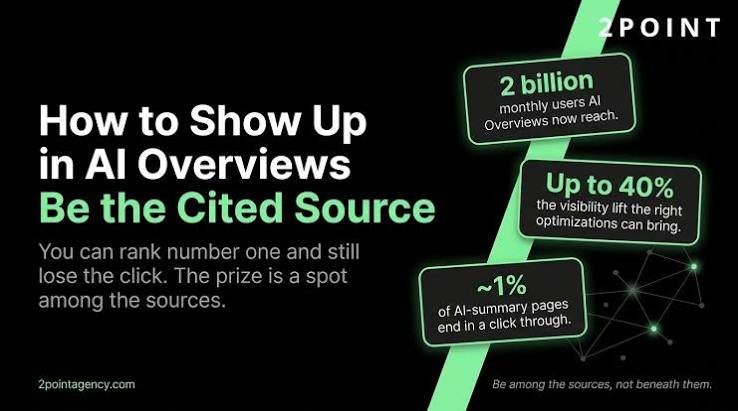
To show up in AI Overviews, your page needs to already rank well in Google, answer a specific question in clear, extractable language within the first few lines, and carry enough authority (through schema, freshness, and third-party mentions on sites like Reddit and Wikipedia) that Google’s AI trusts it as a source. Ranking alone is no longer enough — as of 2026, only about 38% of AI Overview citations come from top-10 organic results, down from 76% in mid-2025, according to Ahrefs data cited by La Teva Web, which means topical authority and content structure now matter as much as position.
What AI Overviews Are And Why Everyone’s Suddenly Talking About Them)
AI Overviews are Google’s AI-generated summaries that sit above the traditional blue links, built using a retrieval-augmented generation (RAG) process. Google interprets a query, pulls relevant documents and signals from its index, and hands them to Gemini to synthesize into a single answer with inline citations back to source pages, as explained in La Teva Web’s breakdown of how AI Overviews work.
They started as the Search Generative Experience (SGE) in 2023, launched officially in the U.S. in May 2024, and have since rolled out to over 100 countries. As of January 2026, users can now expand an overview and ask a follow-up question directly, which pushes them into Google’s more conversational AI Mode without ever leaving the results page — a change that’s only accelerating the shift toward zero-click search, per La Teva Web.
This matters because the numbers on traffic loss are no longer speculative:
- Ahrefs found that when a keyword triggers an AI Overview, clicks to the top organic result drop by an average of 58% as of December 2025, up from 35% in March 2025 (source).
- Seer Interactive’s AIO-CTR study puts the click-through drop as high as 65% — but notes that if your page is actually cited inside the overview, the drop softens to 49%, cited via La Teva Web.
- A broader study of over 300,000 keywords correlated AI Overview presence with a 34.5% decrease in click-through rate for top-ranking pages, reported by True Digital.
- Gartner projects traditional search volume will fall 25% by 2026, and possibly 50% by 2028, as more queries get resolved inside AI answer engines rather than through clicks (reported via Financial Content/PressCable).
- Chartbeat data shared with Axios shows referral traffic from traditional search has fallen 60% for small publishers over the past two years, versus 47% for medium publishers and 22% for large ones — proof that scale and existing authority now cushion the blow (Axios).
The takeaway echoed across Reddit’s r/localseo community and industry blogs alike: this isn’t a reason to abandon SEO, it’s a reason to evolve it. Being cited in an AI Overview is arguably a stronger trust signal than a plain blue link, because Google is vouching for you as a reliable source rather than just ranking you.
When AI Overviews Actually Trigger (And When They Don’t
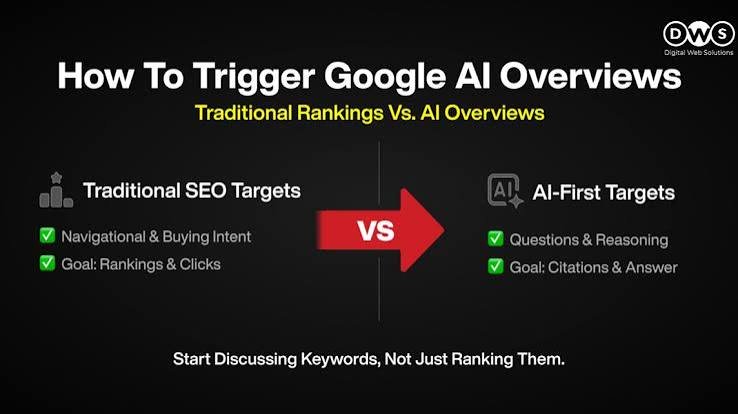
You can’t optimize for AI Overviews everywhere — they’re selective. Understanding when they show up tells you where to focus.
AI Overviews are most likely to appear for:
- Informational, long-tail queries — “what is X,” “how does X work,” “X vs Y,” according to La Teva Web
- Queries phrased as questions rather than bare topics. A page titled “What Is Web Design?” is more likely to trigger an overview than one titled simply “Web Design” (La Teva Web)
- Longer, more specific searches — queries with eight or more words are 7x more likely to trigger an AI Overview than short ones, per True Digital’s analysis
AI Overviews are much less likely to appear for:
- Transactional and commercial searches — only about a 10% chance of triggering, since users want to compare prices or take an action, not read a summary (True Digital)
- Local queries — roughly a 7% appearance rate (True Digital)
- “Your Money or Your Life” (YMYL) topics — sensitive financial, medical, or legal queries like “should I invest in crypto now” or “is ibuprofen safe for pregnancy,” where Google still prefers to send users to established, human-verified sources rather than generate a summary (True Digital)
If you run a content-driven business, digital publication, or affiliate site, this shift hits you the hardest, since AI Overviews compete directly with the “learning” traffic you depend on. Service businesses and e-commerce brands are more insulated, since users still need to complete a transactional action an overview can’t fully satisfy, as La Teva Web points out.
Technical Requirements: The Non-Negotiables
Before any content strategy matters, your page has to be technically eligible. Per True Digital’s guide, your pages need:
- Indexability — no noindex tags, no disallowed robots.txt paths, no login walls blocking the content
- Live status — a clean HTTP 200 response; broken or redirecting pages get excluded
- Standard HTML/AMP format — PDFs and image-only pages typically don’t qualify
- Compliance with Google’s spam policies
- Mobile-friendly, fast-loading design
Run your key pages through Google Search Console’s Page Indexing report to catch disqualifying issues before you invest in content changes.
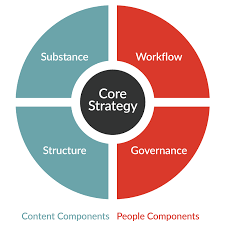
The Core Strategy: How to Actually Get Cited
1. Build the SEO foundation first — it still matters
AI Overviews still lean heavily on organic ranking signals, even as their reliance on the literal top 10 has weakened. Ahrefs’ analysis of 1.9 million citations, referenced by La Teva Web, found that in July 2025, 76% of AI Overview citations came from pages ranked in Google’s top 10. By March 2026, that number had dropped to 38%, with 31% of cited sources ranking between positions 11–100, and another 31% not appearing in the top 100 organic results at all. In practice, this means topical authority on a subject now competes directly with raw ranking position as a citation trigger.
Still, you need the fundamentals in place:
- Fast, stable page performance
- Crawlable, bot-visible HTML (avoid burying content behind JavaScript rendering)
- Clean heading hierarchy (proper H2/H3 use)
- Coherent internal linking
- Structured data that matches the actual on-page content
2. Write in “answer units,” not essays
Google extracts fragments from your page to build the summary — a process often called grounding. The pages that get pulled are the ones that make extraction easy. La Teva Web recommends breaking each article into distinct response units:
- Thesis — a direct answer in 2–4 lines
- Operational definition — what it is, what it isn’t
- Criteria — how to evaluate the options
- Procedure — steps, conditions, limits
- Evidence — data, examples, sources
- Closing — conclusion and next step
This isn’t just theory — True Digital notes that 78% of AI Overviews contain some form of list structure, and that you should write for someone skimming your page in 20 seconds, delivering the core answer in the opening paragraph before expanding.
Length matters too, but not in the way most people assume. True Digital’s research shows AI Overviews under 600 characters cite about five sources, while ones over 6,600 characters cite around 28 — meaning comprehensive, well-organized long-form content has more surface area to get pulled from, not less.
3. Build topical clusters, not one-off articles
Google favors sites that consistently cover a subject over single well-written posts. The recommended structure, per La Teva Web, is a pillar page defining the core topic, supported by satellite pages that each answer one specific sub-question, all interlinked. Results Repeat echoes this — thin, single-angle content rarely makes the cut; depth through examples, explanations, and supporting detail is what earns citation.
4. Target the way people actually phrase questions
Both Results Repeat and True Digital point to the same shift: keyword strategy needs to move from single terms toward natural, conversational phrases — “what’s the best way to,” “how do I,” “why does X happen.” Use tools like Google Search Console, AlsoAsked, or AnswerThePublic to find the actual phrasing your audience uses, then answer that specific phrasing directly.
5. Keep content fresh and mean it
Outdated content is one of the fastest ways to lose visibility. Ahrefs analyzed 17 million citations by channel and found that Gemini, Copilot, and ChatGPT cite noticeably more recent pages than Google’s organic SERP or AI Overviews — content can be up to 25.7% more recent in those tools’ citations, per La Teva Web’s summary of the study. Cosmetic date changes don’t fool this system; substantive updates to statistics, examples, and claims do. True Digital recommends a quarterly review cycle for high-traffic pages, with visible “last updated” timestamps.
6. Add structured data (schema markup)
Implement schema so AI systems can parse your content unambiguously:
- FAQ schema for question-and-answer sections
- How-To schema for step-by-step guides
- Article schema for blog and editorial content
Both True Digital and Results Repeat list this as a baseline requirement, not a nice-to-have. Test every implementation with Google’s Rich Results Test before publishing.
7. Establish real E-E-A-T signals
Generic, AI-written filler content is increasingly filtered out. True Digital recommends detailed author bios with real credentials, links to contributors’ professional backgrounds, and original data or first-hand experience wherever possible — the kind of nuance a generic AI summary can’t fully replicate on its own.
Why Reddit Keeps Coming Up (Because It Actually Matters)
If you’ve spent any time in SEO circles lately, you’ve seen the same claim repeated: Reddit is now one of the most-cited domains inside AI Overviews. True Digital’s research confirms it directly — Reddit is the single most popular site sourced in AI Overviews, ahead of Quora (4% share), NIH.gov (1.8%), and WebMD (1.5%).
This is exactly why threads like r/localseo’s discussion on getting listed in AI Overview and ChatGPT results get so much engagement — practitioners are watching this in real time and comparing notes on what’s actually moving the needle, not just what agencies claim in blog posts. The consensus among SEO communities generally lines up with what the data shows: authentic, detailed discussion threads with specifics (feature names, outcomes, comparisons) are exactly the kind of “plain text” content AI models are trained to extract and trust, because it reads as unfiltered, first-hand experience rather than marketing copy.
Practical takeaways from this trend:
- Participate genuinely in relevant subreddits and Quora threads related to your niche — don’t drop links, answer the actual question
- Encourage detailed, specific customer reviews on public platforms (Yelp, Trustpilot, G2, Tripadvisor) rather than keeping them locked inside Google’s walled garden, since AI models pull directly from public review language, as noted in this breakdown of AI-sourced review data
- Keep those reviews and mentions recent — freshness carries weight here too, both for ranking algorithms and for how AI weighs recency
- Monitor for fake or manipulated reviews, since integrity signals affect how much trust AI extends to a source
As one SEO newsletter put it succinctly, the real goal isn’t just being footnoted — it’s being named in the answer itself, since a citation buried in a source list rarely gets clicked, but a brand named directly in the response text gets remembered (AI Found You).
Building Authority Beyond Your Own Website
AI models don’t just crawl your site — they’re reading what the rest of the internet says about you. True Digital and PR Newswire both emphasize the same fundamentals:
- Keep business listings (Google Business Profile, Bing Places, Yelp, Apple Maps) complete and identically formatted across every platform — consistency builds the trust AI systems use to confirm your details are accurate
- Add business schema markup so AI assistants can pull structured facts like your location, hours, and offerings directly
- Earn mentions in industry media, comparison articles, and “best of” listicles, since a limited number of authoritative domains account for a disproportionate share of AI Overview citations, per the Ahrefs data referenced by La Teva Web
- Publish genuinely useful assets — templates, checklists, original research — that earn links organically rather than through outreach alone
It’s also worth stress-testing whether AI models already understand your brand correctly. A useful diagnostic, outlined in this SEO growth notes guide, is to directly prompt ChatGPT and Google’s AI with questions like “Tell me what you know about [brand name],” “What does [brand name] do?” and “When was [brand name] founded?” If the answers are vague, outdated, or wrong, it usually means there isn’t enough consistent data about your brand across trusted sources — and a well-built FAQ page answering those exact questions is one of the fastest ways to establish that entity-level context.
Common Mistakes That Keep Brands Out of AI Overviews
- Over-relying on generic AI-generated content. True Digital notes that AI systems are increasingly good at detecting and filtering out thin, formulaic writing that lacks first-hand detail.
- Keyword stuffing and over-optimization. This reads as manipulative to AI systems the same way it does to human reviewers.
- Ignoring technical SEO because “content is what matters now.” A weak technical foundation disqualifies even excellent content before it’s ever evaluated.
- Publishing volume over depth. Multiple thin articles perform worse than one comprehensive, well-maintained resource.
- Letting content go stale. Even strong pages lose ground once statistics, examples, or product details fall out of date.
How an AI Search Monitoring Platform Fits Into Your Strategy
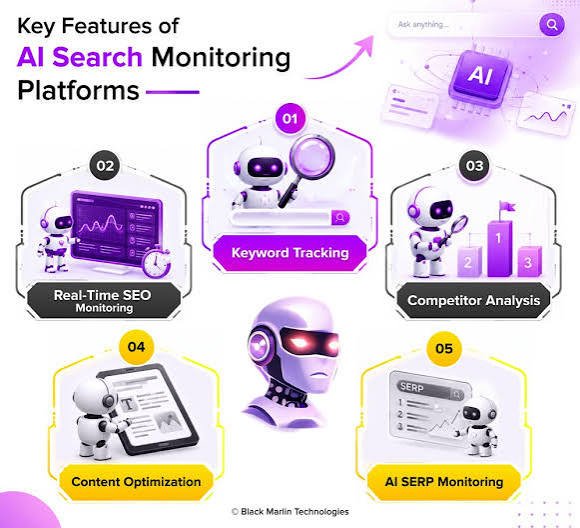
Because Google doesn’t report AI Overview impressions inside Search Console, you’re operating with a visibility gap unless you actively monitor it. This is where AI search monitoring and visibility platforms earn their place in a modern SEO stack — tools like Semrush’s AI Overviews Visibility Checker exist specifically to close that gap.
A monitoring platform typically helps in three concrete ways:
- Surfacing where you’re already winning. If you’re being cited, the priority becomes holding that position — keeping the source content accurate and current, and expanding into adjacent queries where competitors are cited but you aren’t.
- Flagging missed opportunities. A visibility score or “opportunities” report shows exactly which queries in your space are triggering AI Overviews where a competitor is cited and you’re not — a direct roadmap for content updates, rather than guessing.
- Benchmarking against competitors. Rather than manually searching dozens of queries, a platform tracks your share of AI citations over time relative to competing brands, which turns AI visibility into a measurable, trackable KPI instead of an anecdotal feeling.
Other practical ways to track AI citation performance, per Results Repeat and True Digital:
- Manual spot-checks — search your target queries directly and note when and how you appear
- SERP tracking tools with AI Overview detection built in
- Referral traffic segmentation — watch for citation-driven traffic spikes in your analytics, even if overall click volume is down
- Brand mention tracking across AI platforms, not just Google
The strategic shift this enables matters as much as the tooling itself: measuring impressions and citation share, not just clicks, is becoming a core KPI in its own right. As Results Repeat frames it, being featured in an AI Overview functions like the top of the marketing funnel — someone may not click immediately, but brand recognition from that exposure pays off later through direct visits, branded search, and referrals.
Frequently Asked Questions
Can you directly optimize a page to appear in AI Overviews? Not in a guaranteed sense — there’s no dedicated “AI Overview meta tag.” But you can materially improve your odds by combining strong traditional SEO, clearly structured answer-first content, current information, schema markup, and third-party authority signals like reviews and community mentions.
Does ranking #1 on Google guarantee an AI Overview citation? No. Ahrefs’ 2026 data shows only 38% of citations now come from top-10 organic results, down sharply from 76% in mid-2025, per La Teva Web. Topical authority and content clarity now weigh in independently of raw ranking position.
Why does Reddit show up so often in AI Overviews? Because it’s rich in first-hand, detailed, unfiltered discussion — the kind of specific, plain-text content AI models are trained to trust as genuine experience rather than marketing copy, per True Digital’s citation-share data.
Will AI Overviews kill my organic traffic entirely? It will likely reduce click volume on informational queries, but the impact varies by business type. Transactional and local businesses are less affected since AI Overviews rarely appear for those query types. Content-first and publisher sites are hit hardest and need to diversify beyond organic search traffic as their primary channel.
Bottom Line
Showing up in AI Overviews isn’t a separate discipline bolted onto SEO — it’s an extension of the same fundamentals (technical health, authority, freshness, real expertise) applied to a system that now rewards clarity and extractability as much as raw ranking. Combine that foundation with active participation in the communities AI models already trust, like Reddit, and consistent monitoring through an AI visibility platform, and you turn what looks like a traffic threat into one of the highest-trust visibility channels available in 2026.